Case Study
Healthcare Platform
2025
Military Disability Nexus
A conversion-focused website, custom admin system, payments, automated follow-ups, programmatic SEO, and 8+ months of production reliability.
The client did not need “just a website.”
Military Disability Nexus operates in a trust-heavy niche. Their customers are veterans looking for medical documentation support related to VA disability claims. These visitors usually need education, clarity, proof, and confidence before taking action.
The business needed a platform that could handle multiple layers of growth:
- Explain complex services clearly
- Capture serious leads
- Manage sensitive form submissions
- Accept online payments
- Handle file uploads
- Publish educational content
- Create service-specific landing pages
- Build trust through case studies and testimonials
- Support programmatic SEO pages
- Automate emails and follow-ups
- Give the business owner control without depending on developers
The real problem was not design. The real problem was operational scalability.
Every new service page, SEO update, content change, case study, or condition page should not require a developer. The business needed the ability to move fast, publish fast, update fast, and convert visitors into customers without technical friction.
Build a website that acts like a growth engine, not a brochure.
Lead Generation
Turn visitors into inquiries through clear messaging, strong service pages, forms, file uploads, and conversion-focused page structure.
Content & SEO Growth
Publish blogs, case studies, service pages, body system pages, and condition-specific landing pages with full SEO control.
Operational Control
Manage website content, pricing, services, testimonials, leads, files, and pages without needing a developer for every update.
Follow-up & Conversion
Automated emails and follow-up workflows so leads did not simply submit a form and disappear.
A custom growth platform for a niche healthcare business.
Built to guide visitors from confusion to action.
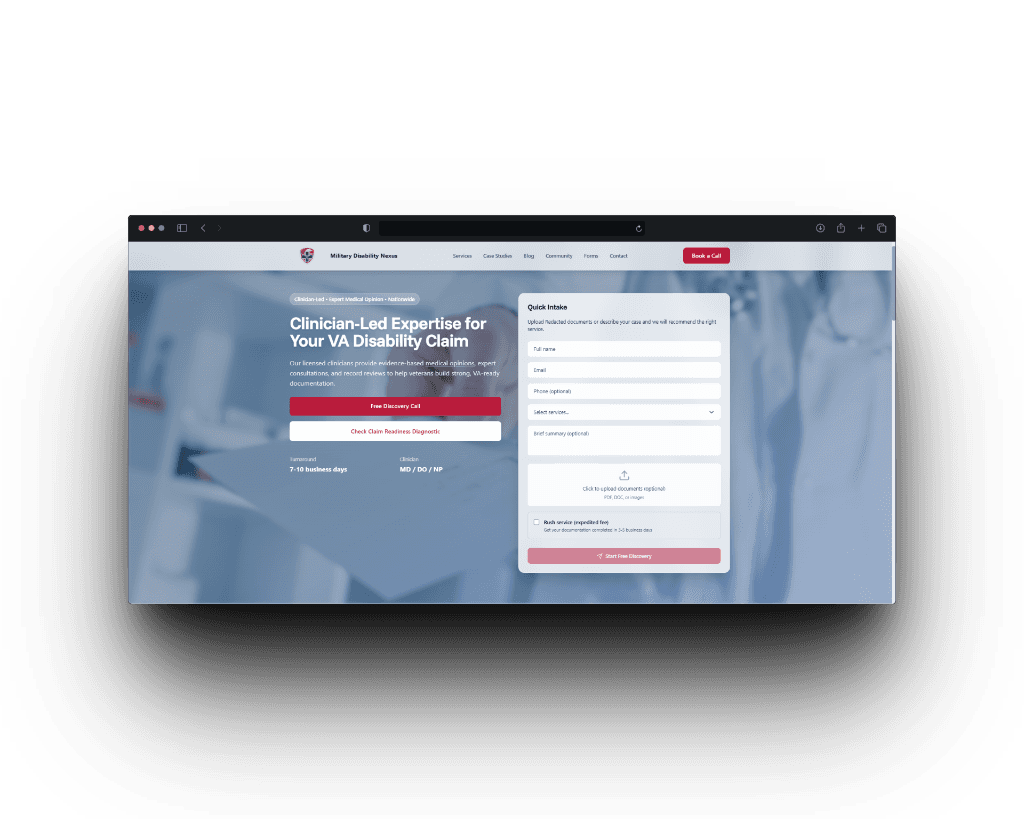
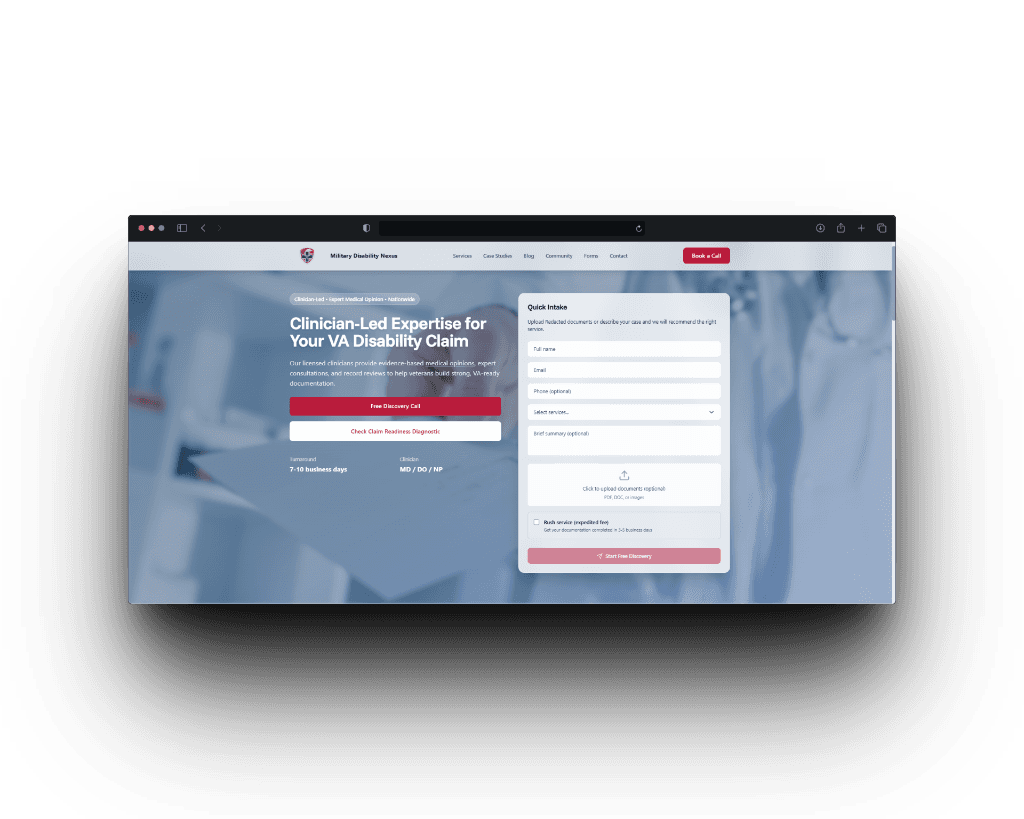
The public website was designed around the buyer journey. Visitors coming to Military Disability Nexus are often trying to understand what type of documentation they need, whether their condition may qualify for additional evidence, and which service is right for their situation.
The website was structured to answer the questions that matter:
- What service do I need?
- What does this documentation help with?
- Is this relevant to my condition?
- Who prepares or reviews this?
- What is included?
- How much does it cost?
- What should I do next?
Instead of creating a generic healthcare website, we built a conversion-focused experience around the actual decision-making process of the customer.
The client manages the business without developers.
Instead of locking the client into a static website where every update requires technical help, we gave them direct control over their content and business assets.
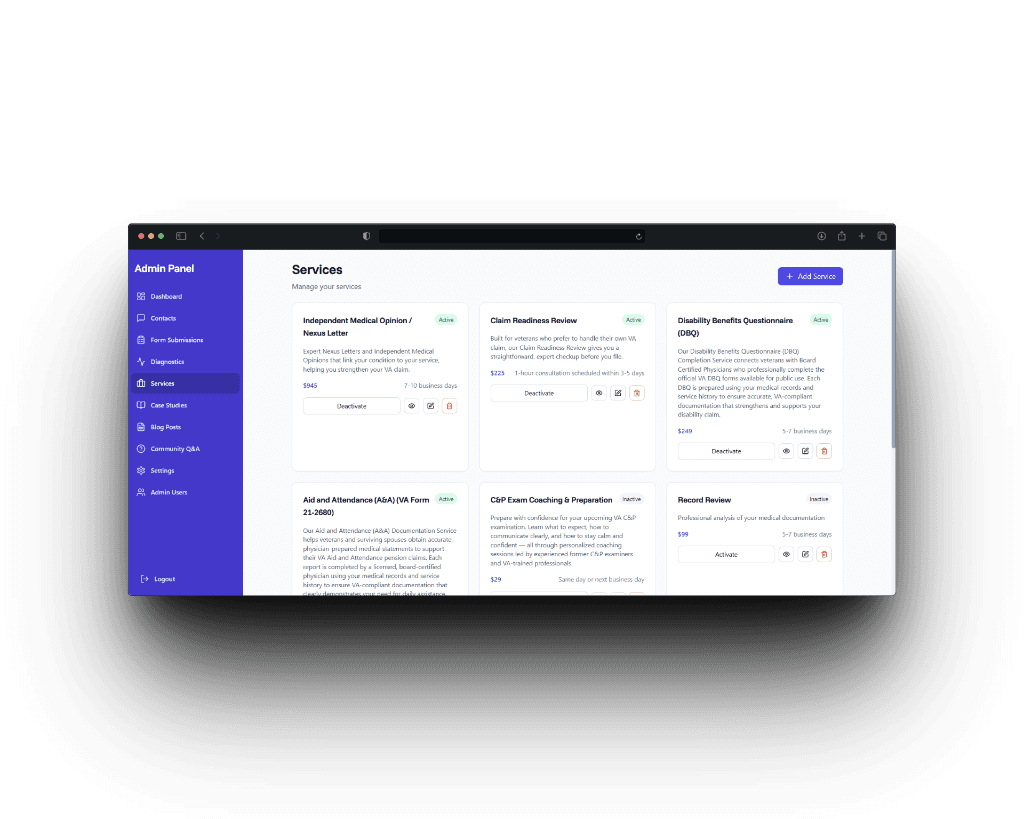
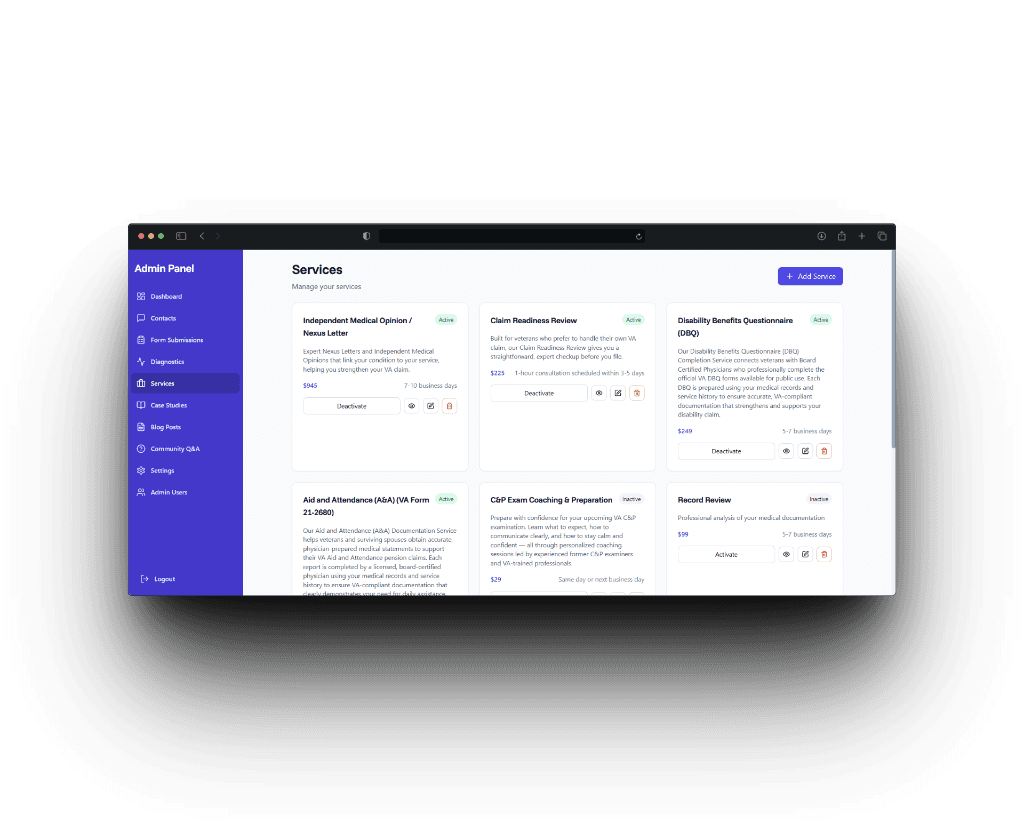
From the admin panel, the client can manage:
- Contacts and captured emails
- Form submissions
- Diagnostic sessions
- Services and pricing tiers
- Body systems and conditions
- Case studies and testimonials
- Clinical profiles
- Blog posts
- Community Q&A
- Uploaded files
New services can be added. Old content can be updated. SEO metadata can be changed. Case studies can be published. Pricing can be adjusted. Blog posts can go live. No developer bottleneck.
Create, edit, and optimize service pages directly.
Military Disability Nexus offers multiple specialized services, including nexus letters, DBQs, claim readiness reviews, Aid & Attendance documentation, TDIU documentation, and more.
For each service page, the client can manage:
- Service title and URL slug
- Short and full descriptions
- AI-citable lead/subtitle
- Service category and pricing
- Timeline and display order
- Active/inactive status
- SEO title, keywords, and description
- Features and FAQs
This means the business can launch or update service pages quickly without waiting for engineering work. For the owner, this turns the website into a flexible sales asset.
Built for long-term organic growth.
This was one of the most valuable parts of the build. The business needed a scalable SEO structure that could support many specific search intents.
We built a programmatic SEO system around body systems and medical conditions:
- Neurology, Mental Health, Gastrointestinal
- Respiratory, Musculoskeletal, Dermatology
- Audiology, Cancer/Oncology, Nephrology
Each condition page can be customized with:
- Hero heading and description
- Page slug and overview content
- SEO keywords and metadata
- FAQs and specialist guide
- Related services and pages
- Custom sections and publishing controls
This gives the business a repeatable content system for targeting high-intent search traffic. That is the difference between a website and an SEO growth engine.
Real transactions, not just inquiries.
A website becomes much more valuable when it does not only collect leads, but also helps move customers closer to purchase.
Education → Service selection → Inquiry → Payment → Onboarding → Follow-up
This makes the website more than a marketing channel. It becomes part of the revenue system.
Automated follow-ups reduce lead drop-off:
- Confirm form submissions automatically
- Send relevant next steps
- Follow up with leads on schedule
- Reduce manual communication work
- Keep prospects engaged after inquiry
- Support a professional customer experience
Built for sensitive data.
The platform includes form submission management so the business can view and track incoming leads from one place.
The admin dashboard shows key lead details:
- Name and contact information
- Form type and submission status
- Uploaded files and submission date
- Available admin actions
Because Military Disability Nexus operates in a healthcare documentation niche, the platform was built with HIPAA-compliant handling. Privacy, trust, and security are essential to the customer experience.
Fewer missed leads, better organization, faster response, and responsible data handling.
Trust-building content and community.
In this industry, visitors need proof. They want to understand what happens in real claim scenarios, what documentation gaps look like, and how certain services may help.
The platform includes a complete content system:
- Case study CMS with tags, excerpts, and view tracking
- Blog management for educational articles
- Diagnostic analytics with sessions, conversions, and score distribution
- Community Q&A section for user discussions
For businesses in complex niches, community becomes a strong asset. It keeps visitors engaged and creates more reasons to return. Think of it as a lightweight Reddit-style community inside the business website.
The platform handles leads, payments, forms, content, emails, follow-ups, and customer interactions. Reliability is not optional.
From static website to growth platform.
Website updates required technical help
Client can manage major content from admin panel
Limited scalability for SEO pages
Programmatic SEO system for body systems and conditions
Service pages were harder to scale
Services can be created, edited, priced, and optimized from dashboard
Lead management could become scattered
Form submissions and files are centralized
Follow-ups required more manual effort
Automated emails and follow-up workflows are built in
Website acted mainly as a marketing asset
Platform supports marketing, operations, payments, and content
Content growth depended on development cycles
Blogs, case studies, conditions, and services can be published directly
Trust assets were harder to manage
Testimonials and case studies can be added anytime
No lightweight community layer
Community Q&A built into the website
No long-term proof of platform stability
8+ months in production with 100% uptime
Most websites become outdated because the business cannot move fast enough.
A traditional website looks good on launch day. But a few months later, the business changes. New services are added. Pricing changes. New questions come up. SEO opportunities appear. Case studies need to be published. Leads need better follow-up.
If every update requires a developer, the website becomes slow, expensive, and frustrating to maintain.
That is what we solve.
We build websites that business owners can actually operate. Not static brochures. Not generic templates. Not “pretty pages” that do nothing after launch.
We build growth platforms that help businesses capture leads, publish content, automate follow-ups, accept payments, and keep improving without technical friction.
This was not a template build.
The platform was designed around the actual business model. That is why the final product is much more powerful than a normal business website. It does not just display information. It helps the business operate.
Military Disability Nexus needed a system built around their actual business model. That meant understanding:
A serious service business does not need “just a website.”
It needs a system.
A system that captures demand.
A system that builds trust.
A system that educates prospects.
A system that follows up.
A system that helps the team manage leads.
A system that supports SEO growth.
A system that keeps working after launch.
Want a website that works like a growth platform?
If your business depends on leads, trust, content, payments, or follow-up, a basic website is probably not enough.